Why Doesn't the Moon Follow the Sun's Path?
If you watched the sky every day for a year, you would notice that the Sun follows a path that shifts predictably north and south with the seasons — at any particular time of year, it is easy to predict where the Sun will rise, where it will set, and how high it will climb in the sky.
The Moon is different.
Sometimes a Full Moon climbs higher than the Sun ever reaches. At other times it follows a much lower path. Over many years, its rising and setting positions slowly drift north and south along the horizon before eventually returning to where they started.
Why?
The answer involves a 5.1° tilt, a 27.3-day orbit, and a little-known 18.6-year cycle that most people never notice.
The Moon Has Its Own Tilt
Most people know that the Earth is tilted about 23.4° relative to its orbit around the Sun. That tilt causes the seasons and explains why the Sun appears high in the sky during summer and low in the sky during winter.
Fewer people know that the Moon's orbit is also tilted. The Moon's orbital plane is tilted about 5.1° relative to the Earth's orbit around the Sun. Astronomers believe this inclination is a consequence of the giant collision that created the Moon approximately 4.5 billion years ago. The exact angle is not special; it is simply the angle that remained after the Earth-Moon system settled into its present form.
When the Moon reaches its highest point in the sky, it may appear as much as 5.1° above or below the Sun's apparent path through the sky.
For reference, a Full Moon reaches its highest point at approximately midnight (neglecting daylight savings time), while a New Moon reaches its highest point at approximately noon. First Quarter and Last Quarter Moons reach their highest points at approximately sunset and sunrise respectively. These times vary slightly throughout the year and by location, but they are close enough for understanding the geometry.
A Simpler Solar System
To understand the Moon's 18.6-year cycle, it helps to temporarily simplify the Solar System.
Imagine that Earth's axis has no tilt at all. That is, instead of 23.4 degrees, in our model it is 0 degrees. In this simplified world, the Sun always rises due east, always sets due west, and always follows the same path through the sky. There are no seasons. This is obviously not our real Solar System, but it makes the geometry much easier to understand.
The Moon still orbits Earth every 27.3 days. The Moon's orbit is still tilted by 5.1°. The 18.6-year cycle still exists. By removing Earth's 23.4° tilt, we can focus entirely on what the Moon is doing.
The Record Player Analogy
Imagine a vinyl record spinning on a record player. The spindle at the center represents Earth. A small mark on the record's outer edge represents the Moon. Each trip around the spindle represents one orbit of the Moon around Earth. In reality, that takes about 27.3 days.
Now place the entire record player on a giant lazy Susan. Tilt the record player slightly so that the record surface is inclined by 5.1°. That tilt represents the inclination of the Moon's orbit. At the center of the lazy Susan is the Sun, located very far away.
The Sun remains fixed. The record player remains tilted by exactly 5.1°. The mark representing the Moon continues to orbit Earth every 27.3 days.
The only thing that changes is the orientation of the record player on the lazy Susan.
One complete revolution of the lazy Susan takes 18.6 years.
To simplify the discussion, imagine taking a snapshot once each year on January 1st (the day doesn't matter — it's just a day). We are not interested in where the Moon happens to be during its monthly orbit. We are only interested in the orientation of the tilted record player relative to the Sun.
At Year 0, the record player is oriented so that the Moon's orbital plane appears tilted by the full 5.1° above the Sun's path through the sky. In this position, both a Full Moon and a New Moon reach points approximately 5.1° above the Sun's path.
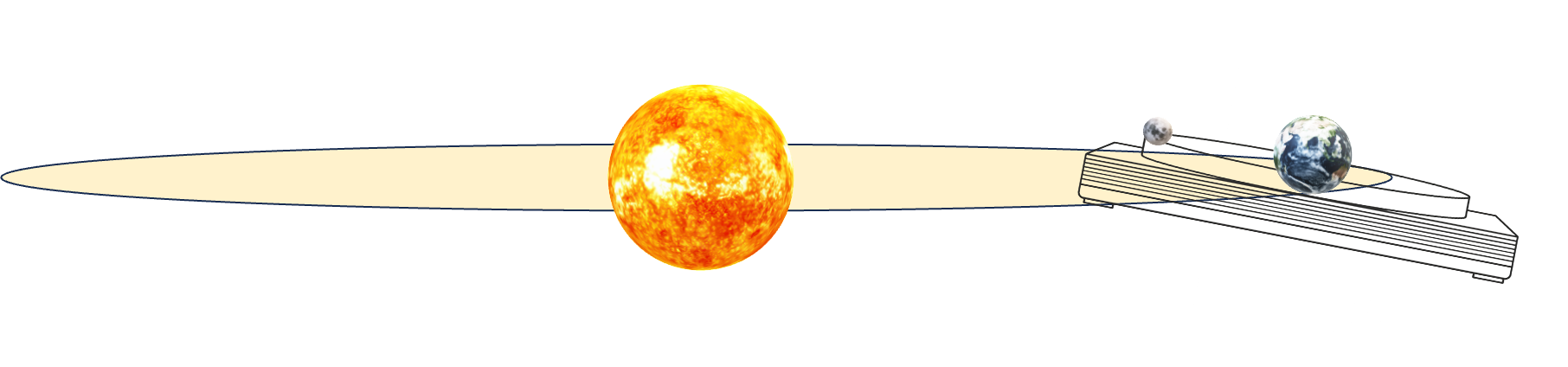
At Year 4.65, the lazy Susan has rotated one-quarter turn. The record player is still tilted by exactly 5.1°. Nothing about the tilt has changed. However, from the Earth's perspective, the Moon's orbital plane now appears aligned with the Sun's plane. The Moon still follows a tilted orbit in three-dimensional space, but that tilt is now directed sideways relative to the Sun. As a result, both the Full Moon and the New Moon follow the same apparent path as the Sun. The 5.1° inclination has not disappeared. We are simply viewing it edge-on.

At Year 9.3, the lazy Susan has rotated halfway around. The record player still has exactly the same 5.1° tilt. At Year 0, the Moon's path appeared 5.1° above the Sun's path. Now it appears 5.1° below the Sun's path. Nothing else has changed.
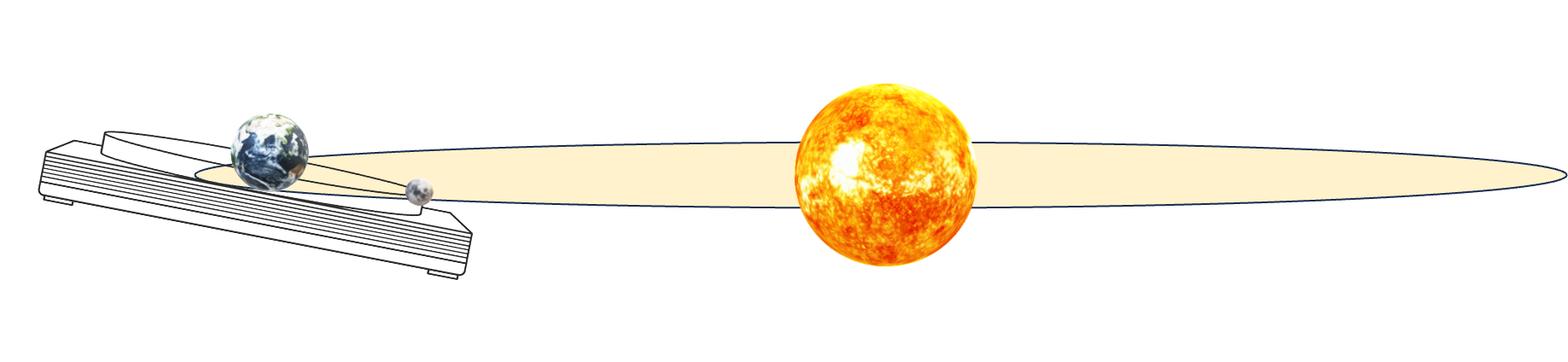
At Year 13.95, the lazy Susan has rotated another quarter turn. Once again, the Moon's apparent path aligns with the Sun's path. The inclination still exists, but from Earth's perspective it is directed sideways and no longer appears above or below the Sun's path.
At Year 18.6, the lazy Susan has completed one full revolution. The system has returned to its original orientation and the cycle repeats.
The important point is that the Moon does not spend 18.6 years traveling around a giant orbit. The Moon still circles Earth every 27.3 days. What takes 18.6 years is the slow rotation of the orientation of that orbit relative to the Sun.
Where Are We Today?
The record-player analogy describes a complete 18.6-year cycle. The most recent major lunar standstill occurred during 2024–2025. Using that as our starting point, the table below shows where we are in the current cycle and what the orientation of the Moon's orbit looks like relative to the Sun.
| Position in Cycle | Approximate Date | What You Would Observe |
|---|---|---|
| Major Standstill | 2024–2025 | Moon's path appears about 5.1° above the Sun's path |
| Quarter Turn | 2029–2030 | Moon's path aligns with the Sun's path |
| Minor Standstill | 2033–2034 | Moon's path appears about 5.1° below the Sun's path |
| Three-Quarter Turn | 2038–2039 | Moon's path aligns with the Sun's path again |
| Major Standstill | 2043–2044 | Cycle repeats |
Returning to the Real Earth
Up to this point we have intentionally ignored Earth's 23.4° axial tilt. In the real Solar System, that tilt causes the Sun's path through the sky to change throughout the year and gives us our seasons.
The Moon's 5.1° orbital inclination is therefore added to, or subtracted from, Earth's much larger 23.4° tilt. As a result, the Moon can sometimes travel noticeably higher than the Sun's path and at other times noticeably lower. This is why some Full Moons climb unusually high in the sky while others remain unusually low.
The simplified model explains the underlying mechanism. The real Earth adds another layer of complexity, but the fundamental idea remains unchanged.
The numbers make it concrete. At the 2024–2025 major standstill, the Moon's 5.1° inclination added directly on top of Earth's 23.4° tilt, giving a maximum lunar declination of about 28.5°. That is the highest the Moon can climb — and it will not reach that height again until 2043. Nine years from now, at the minor standstill, the inclination will subtract instead of add, and the Moon's maximum declination will drop to about 18.3°. The difference — a Full Moon near the winter solstice riding noticeably higher or lower in the sky — is visible to the naked eye if you know what to look for.
The Moon's 18.6-year cycle is not caused by the Moon changing its tilt. The Moon's orbital inclination remains close to 5.1°. What changes is the direction in which that tilt points. Once that idea clicks, the entire cycle becomes much easier to understand.