Can the Sun Rise and Set to the North?
Yes, and it happens every summer if you are north of the Tropic of Cancer.
This feels counterintuitive because we know the Sun is “in the south” at midday in the northern hemisphere. So how can it both rise and set north of due east-west?
Let's start with a familiar reference point. At the summer solstice (approximately June 21) at the Tropic of Cancer (approximately 23.4° north latitude), the Sun is directly overhead at noon. On that day, the Sun rises due east and sets due west. This is the one place where the Sun’s path is centered perfectly on the east–west line.
Now go much farther north. At the Arctic Circle (about 66.6° north latitude), the Sun does not set at all on June 21. At midnight, it sits on the northern horizon, exactly due north. If you move just a little south of the Arctic Circle, the Sun dips slightly below the horizon at night, setting in the north-north-northwest and rising again in the north-north-northeast — both extremely close to due north.
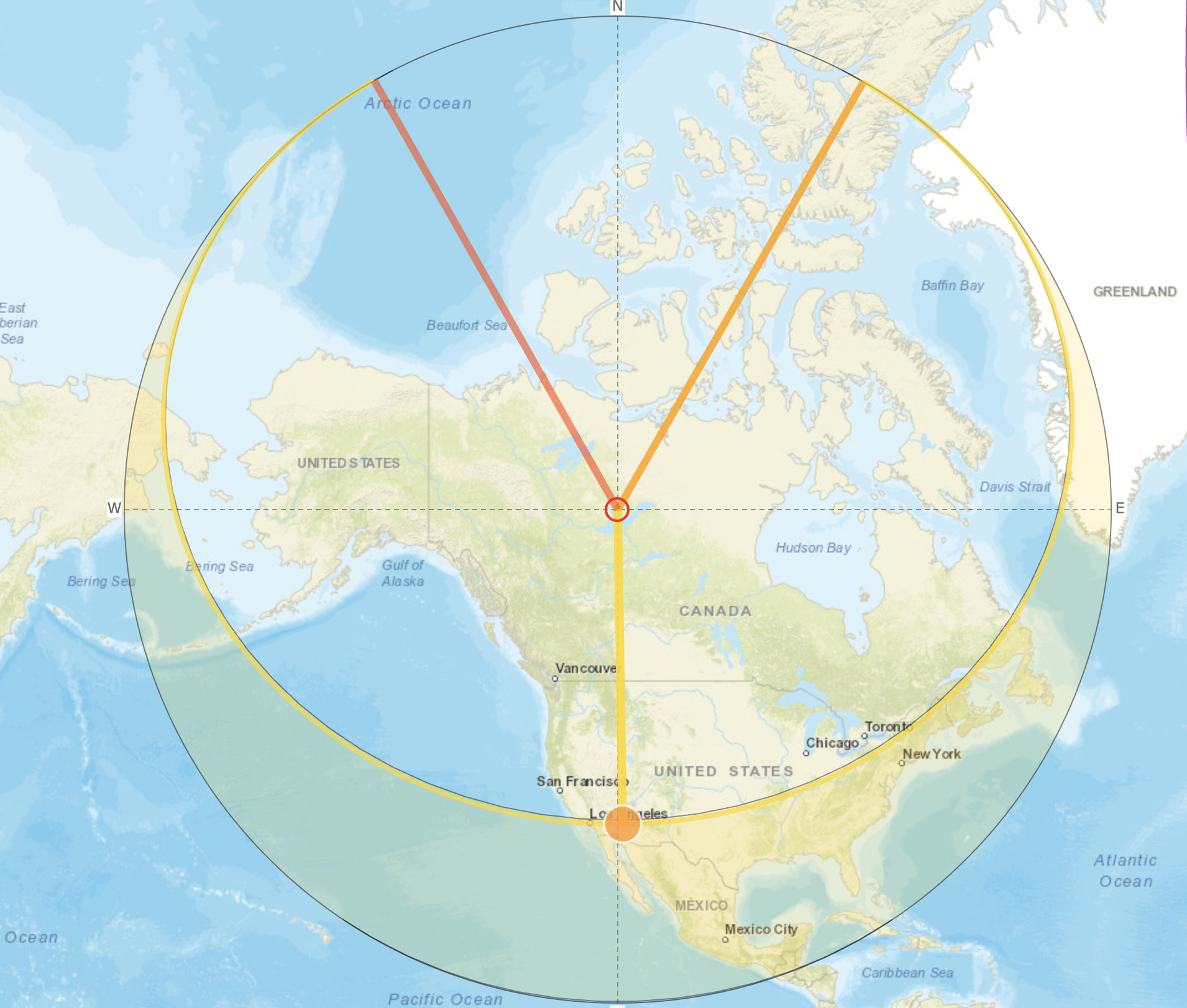
The observer is at the small circle in Yellowknife, Northwest Territories. The Sun rises along the light orange line, reaches solar noon along the yellow line, and sets along the dark orange line. Note that both sunrise and sunset occur north of the observer, while the Sun is due south at solar noon.
Image credit: Sun path visualization from SunCalc by Torsten Hoffmann, using Yellowknife, Northwest Territories settings.
The reason for this is that the Sun does not move along a line of latitude. It traces a tilted arc across the sky. In summer, that arc is high and shifted toward the north. The middle of the path, at noon, is still toward the south, but the ends of the path—sunrise and sunset—extend into the northern half of the horizon.
The Sun's path changes smoothly with latitude. That allows us to connect these two extremes. At the Tropic of Cancer, sunrise is due east. Near the Arctic Circle, sunrise occurs very close to due north. Since there is no sudden jump in between, the direction of sunrise must shift gradually as you move north.
To see how this plays out locally, consider San Francisco at about 38° north latitude. On June 21, the Sun rises at about 58°, well north of east, and sets at about 302°, well north of west. If you face west to watch the sunset in June, you will notice it is far to the right of due west, toward the northwest.
What about the equator?
Now, let's step back and include the equator. At the equator on June 21, the Sun also rises north of east and sets north of west. From there, as you move north toward the Tropic of Cancer, the sunrise and sunset points shift gradually toward due east and west. At exactly 23.4° north, they reach due east and due west. Continuing north beyond that, they shift back toward the north again, becoming more pronounced with increasing latitude.
This creates a smooth progression. At the equator, sunrise is clearly in the northeast. At the Tropic of Cancer, it is due east. At mid-latitudes such as San Francisco, it is again in the northeast. Near the Arctic Circle, it approaches due north.
It is natural to think that if the Sun is south of you, it should rise and set to the south. The missing piece is that the Sun’s position at noon and the full path it traces across the sky are different things. On June 21, the arc of the Sun’s path is shifted far enough north that even though the Sun is due south at midday, the ends of that arc land in the northern part of the horizon.
The result is simple once seen clearly: on June 21, the Sun can—and does—rise and set to the north.
What about the equinox and winter solstice?
At the equinox, the pattern becomes simple again. In San Francisco and everywhere else on Earth, the Sun rises due east and sets due west, with its path centered on the east–west latitude line. The northward shift seen in summer disappears entirely.
At the winter solstice in San Francisco, the pattern reverses. The Sun rises well south of east and sets well south of west, with the entire path shifted toward the southern sky.
| Date | Sunrise | Sunset | Direction shift |
|---|---|---|---|
| June 21 | ~58° (NE) | ~302° (NW) | 32° north of east/west |
| Equinox | 90° (E) | 270° (W) | centered |
| Dec 21 | ~122° (SE) | ~238° (SW) | 32° south of east/west |